Solar Generator for RV
Start with the question everyone actually has, because the honest answer changes what you buy: no, a portable solar generator will not run your rooftop air conditioner for a weekend. Here is what it will run, how to size it properly, and which unit fits.
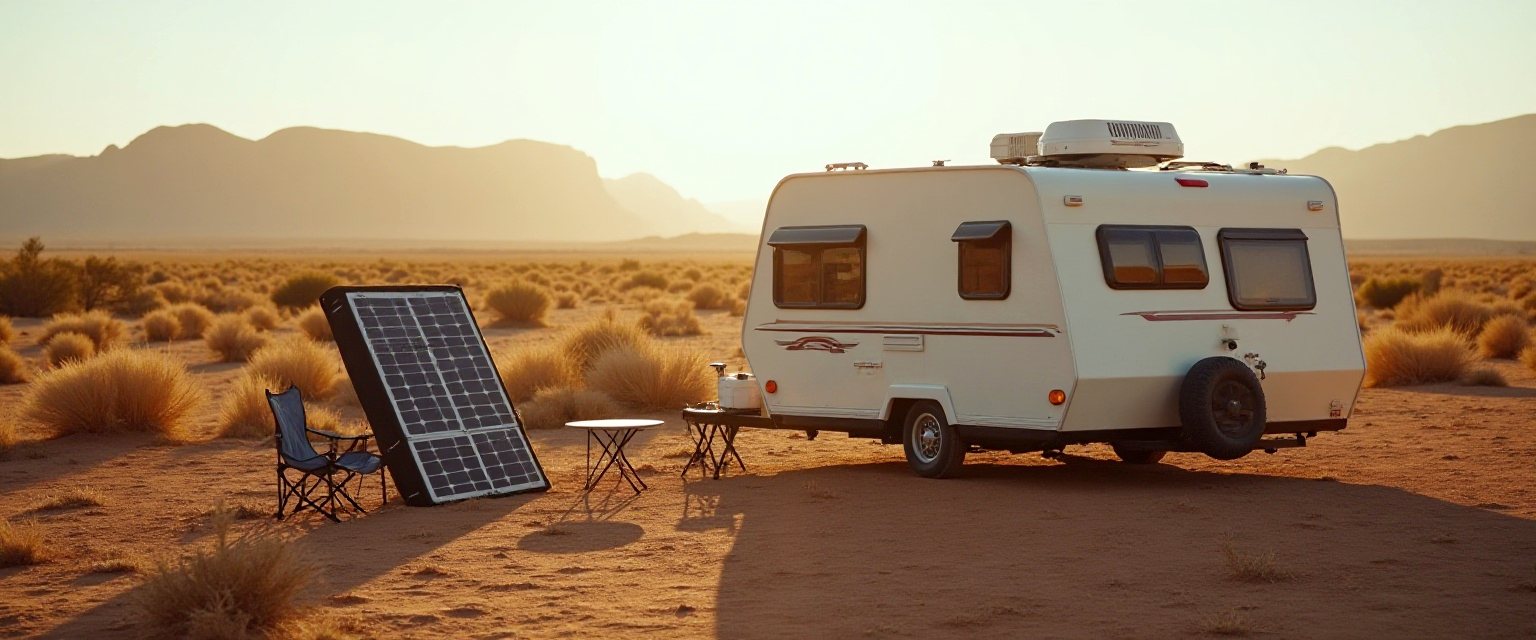
The air conditioning answer, first
A standard 13,500 BTU rooftop RV air conditioner draws roughly 1,500 to 1,800 running watts, and the compressor surges to two or three times that on startup. Running it needs an inverter that can absorb the surge, and sustaining it needs storage measured in the thousands of watt-hours per hour of use.
Published guidance puts a full-time rig running rooftop AC for two to three hours a day at 10,000 to 14,000 watt-hours daily. That is not a portable power station. That is a house battery bank.
a portable unit can run your air conditioner for a short stretch — an hour or two on a big unit, to take the edge off in the afternoon — and it cannot cool your rig overnight. Anyone selling you differently is selling you something. Plan your cooling around shade, ventilation, altitude and campground hookups, and buy your solar generator for everything else.
Work out your actual daily watt-hours
Everything else follows from one number: what you consume in twenty-four hours. Four realistic profiles, built from typical draws rather than nameplate maximums:
| Profile | Daily use |
|---|---|
| Weekend — cooler, fan, phones, lights | ~880 Wh |
| Weekend plus a CPAP | ~1,330 Wh |
| Full-timer, no air conditioning | ~1,400 Wh |
| Class A, residential fridge, induction cooktop | 6,500–9,000 Wh |
Two things in that table surprise people. A 12-volt cooler is the largest sustained load in most camps — a compressor drawing 50 watts at a 40 percent duty cycle averages 20 watts, which is 480 Wh over a day. And a CPAP nearly doubles a weekend load on its own: a common unit pulls 56 watts continuously, so an eight-hour night is 448 Wh.
Then size it with two rules
Battery: 1.5 times your daily need. That is what carries you through a cloudy day without starting the truck.
Solar: enough to replace one full day of consumption in five peak sun hours. Panels do not deliver their rated output in the field — plan on roughly 70 to 85 percent of the number on the box, less in heat, less again at an angle. A 100-watt panel in good sun returns something like 400 to 500 Wh across a day, not 800.
Run the weekend-plus-CPAP profile through both: 1,330 Wh daily means about 2,000 Wh of battery and 300 to 400 watts of panel. That is a specific, buyable answer rather than a vague one.

Three things that quietly ruin the maths
Inverter idle drain. A 3,000-watt inverter consumes 30 to 50 watts doing nothing at all. Left on for twenty-four hours that is 720 to 1,200 Wh — frequently more than your fridge uses. A smaller unit idles at a fraction of it. Buying the biggest inverter you can afford is often the wrong move for off-grid use, and switching the inverter off when nothing needs AC power is free capacity.
Running a 12-volt fridge through the inverter. If your fridge is 12-volt DC and your power station has a 12-volt output, use it directly. Going through the inverter to convert DC to AC and back to DC wastes roughly 30 percent of that load for nothing.
Battery chemistry. LiFePO4 rates around 3,000-plus cycles to 80 percent capacity. Older lithium-ion NMC packs rate 800 to 1,000 — about two to three years of full-time use against eight to ten. For weekends the difference is academic. For full-timing it decides whether you buy once or twice.
Matching a unit to your profile
These are affiliate links. Prices and specifications were checked in September 2026 — confirm both on the product page, because they move. We would rather send you to the right size than the expensive one.
Weekends and small loads — phones, lights, a fan
Explorer 300 holds 293 Wh with a 300 W inverter and 500 W surge, at $259. Be clear about what that covers: devices, lights, a fan, a laptop. It will not run a CPAP overnight — a common machine draws 448 Wh a night on its own, more than this unit holds. It is a device-charging tool, not a camp power system, and plenty of weekend campers genuinely need nothing more.
A CPAP, a cooler and real camp loads — 1,000 to 1,500 Wh a day
Explorer 1000 is the sensible answer: 1,070 Wh and a 1,500 W inverter, currently $499, reduced from $559. That covers a CPAP night with room for a cooler and devices. It sits just under the 1.5× rule for the weekend-plus-CPAP profile, so pair it with a SolarSaga 200W to replace what you use each day rather than draining down across a trip.
Extended boondocking without air conditioning — 1,400 Wh and up
Solar Generator 2000 Plus is the pick, and for an unusual reason: at $2,399 the bundle costs less than the bare unit does. Same 2,042.8 Wh and 3,000 W inverter as Explorer 2000 Plus at $2,499, with a panel included. Unless something has changed since we checked, buying the bundle is strictly better than buying the unit alone.
That capacity covers the full-timer profile with margin — fridge, microwave in bursts, induction burner, tools, devices.
The air conditioning question, answered numerically
The 3,000 W inverter on the 2000 Plus units will start and run a 13,500 BTU rooftop air conditioner — that is what the surge headroom is for. The limit is energy, not power. At 2,042.8 Wh against a 1,500 W running draw, you get roughly 1.3 hours before the unit is empty.
That is a real, useful hour in the afternoon heat. It is not overnight cooling, and no portable unit on your list will be.
Panels: how many watts
Match panel wattage to replacing your daily draw in about five usable hours, then add margin for heat and angle.
SolarSaga 100 Air — now sold as the SolarSaga 100 Air, $249 — is the workhorse; two of them replace roughly a kilowatt-hour a day in good conditions. SolarSaga 200W at $379 is what you want if you are running a 2,000 Wh unit down each day and need it back by evening.
What this setup will not do
It will not run rooftop air conditioning overnight. It will not replace a properly installed house battery bank and roof array for full-time living. It will not charge meaningfully in dense shade or heavy overcast, which is exactly when you want power most. And it will not survive being sized off nameplate wattage instead of watt-hours — the single most common mistake in this category.
What it will do is run a realistic camp quietly, without fuel, without noise ordinances, and without the maintenance a gas generator needs.
Common questions
Can I run a microwave?
In short bursts, yes, on the larger units — a 1,000-watt microwave for a few minutes is a small energy cost even though it is a large power draw. Power and energy are different questions, and confusing them is why people buy the wrong unit.
How long will a 2,000 Wh unit last?
Divide by your real daily consumption, not by a single appliance. At the 1,400 Wh full-timer profile it is roughly a day and a half with nothing coming in from solar.
Do I need a 30-amp or 50-amp setup?
That describes your shore power connection rather than your battery. A 30-amp rig running one rooftop AC typically wants 2,000 to 3,000 watts of inverter capacity; a 50-amp rig with two air conditioners is well past what portable units do.
Can I charge while driving?
Most of these units accept 12-volt car charging, which is slow but genuinely useful — a few hours of highway makes a real difference to the next night.
Dominion Solar Pro earns a commission on purchases made through the Jackery links on this page, at no cost to you. Specifications quoted are published ratings; confirm current specs and pricing on the product page before purchase.